Visual Biography
Explore Shirley S. Abrahamson’s life in pictures, or click here to read the full-text version.
Contents: Early Life | Legal Career | Judicial Career
Early Life
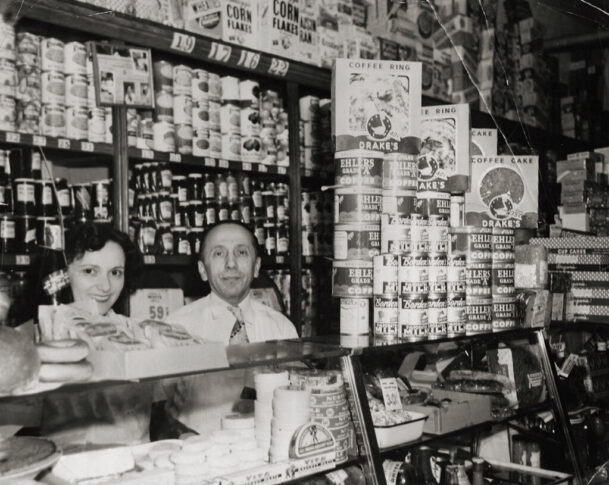
Shirley’s Parents, Leo Schlanger and Ceil Sauerteig
Shirley’s parents, Leo Schlanger and Ceil Sauerteig, were Jewish immigrants from Poland. They ran a grocery store in New York and, for a time, in New Jersey.
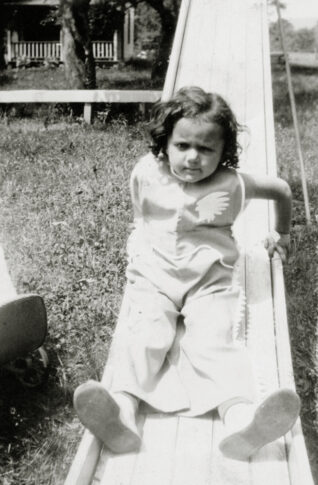
Future President?
Shirley was born on Dec. 17, 1933, just after her mother arrived in the U.S. They joked that the timing meant that Shirley could become President.
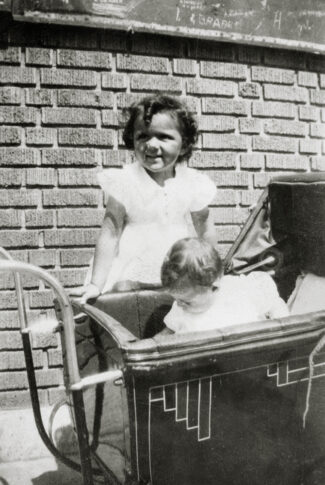
Shirley and Baby Sister Rosalind
When Shirley was 22 months old, her sister Rosalind (referred to as Roz) was born.
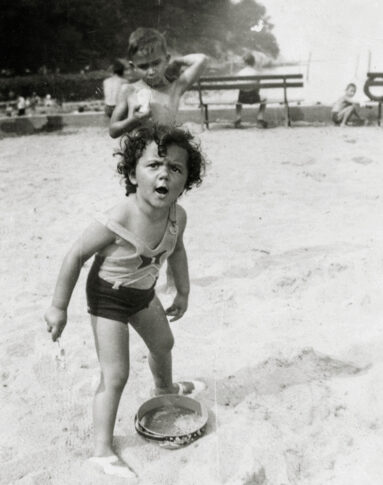
Shirley at the Beach
Shirley grew up in New York and New Jersey. She frequently visited the beach with her family.
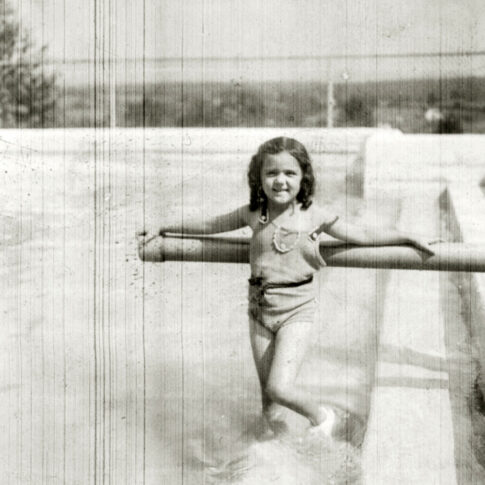
Homework in Kindergarten
Shirley’s sister Roz was an athlete. She played basketball and liked riding her bike around New York City. Shirley, on the other hand, loved going to school and enjoyed reading in her spare time. Her mom said she was the only child who claimed to have homework in kindergarten.
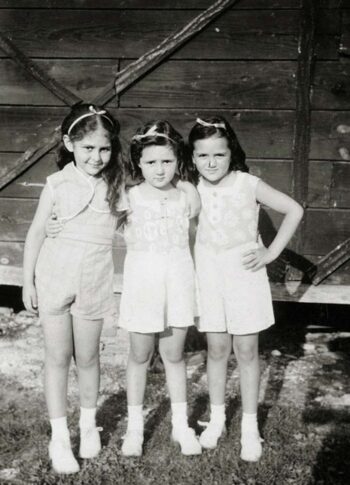
Future Teacher?
As a young child, Shirley wanted to be a teacher. She lined up her sister Roz and her dolls and tried to teach them. Roz wouldn’t sit still, and Shirley gave up on teaching.
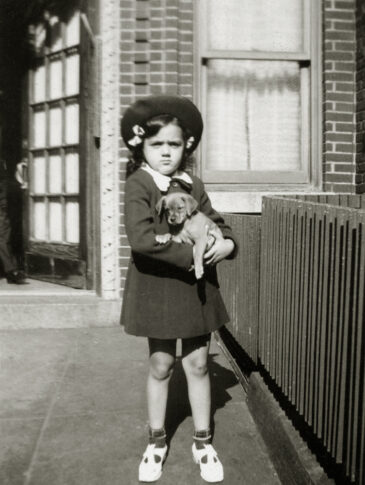
The Future Lawyer
When Shirley was 4, she wanted to be President. At age 6, she changed her career plans. She decided to be a lawyer. Her parents never discouraged her.
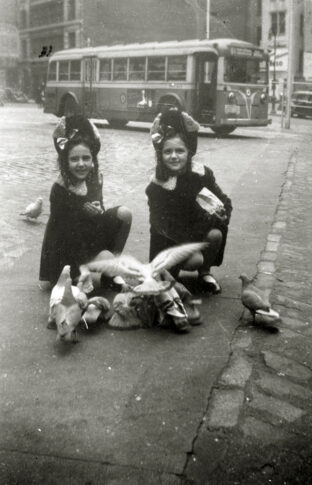
Fashionable Clothes
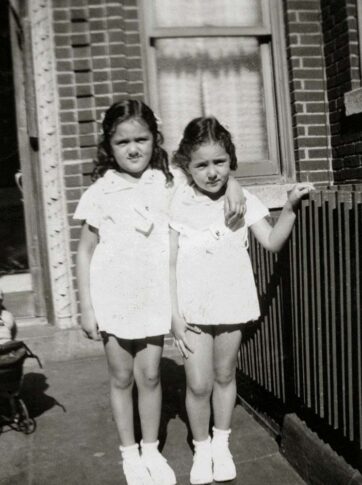
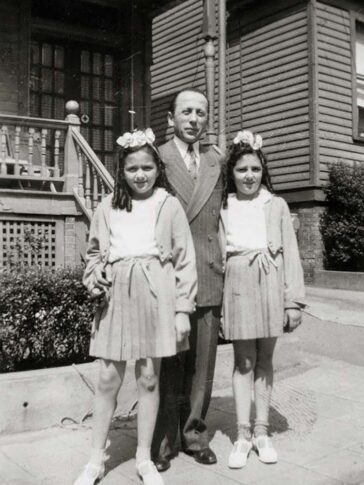
While living in Poland, Shirley’s mother was a talented seamstress and had a good fashion sense. In the U.S., she worked in the family grocery store, but continued to make clothes for her girls.
An Influential Teacher
Shirley’s favorite grade school teacher was Miss Hauptman. In her civics class, Hauptman stressed constitutional rights, even for minorities. Her class made a significant impression on Shirley.
Injustice at the Library
Shirley lived in New Jersey for a few years during grade school. The public library, at that time, refused to give her a library card because her family did not own property. She thought that was unfair.

A Great Love of School
Shirley loved going to school. When not at school, she preferred to be home. She hated going to summer camps and did not like sleepovers.

High School at Age 12
Shirley excelled academically, skipping several grades in school. She started Hunter College High School in New York when she was just 12 years old.

Drawn to Student Government
Shirley enjoyed participating in student government activities at Hunter College High School. She worked long and hard on several campaigns.

Studying Hard
Shirley loved high school. She worked hard to get As.

The Sibling Relationship
Shirley and her younger sister Roz shared a bedroom in their family home. While they had very different interests and friends, they got along well. Later in life, they especially enjoyed traveling together.

Meeting at Summer Camp
Shirley met her future husband, Seymour Abrahamson, during high school when the two were working at a summer camp.

The Courtship Begins
Shirley began dating Seymour during her senior year of high school while he was finishing Rutgers University in New Jersey.

Graduating from High School
Shirley graduated from Hunter College High School in 1950.

College Friends
Shirley decided to attend New York University because her friend Kitty had a sister who was going to college there.

Dorm Life
Shirley attended New York University, majoring in Political Science and minoring in English Literature. She also studied French, Spanish, History, Sociology, and Philosophy.

Shirley and Seymour Get Engaged
Shirley and Seymour became engaged when she was 18. Her father was delighted because he feared she was becoming too educated to attract a man. Her mother liked Seymour but thought that Shirley was too young to marry.

Graduating College with Honors
Shirley graduated Phi Beta Kappa from New York University in three years.

Shirley and Seymour Marry
After graduating from NYU, Shirley Schlanger married Seymour Abrahamson in 1953. She was 19 years old.

Shirley and Seymour’s Formal Wedding
Shirley’s parents wanted to host a nice wedding complete with a white gown. Her mom handled the details.
Legal Career

Shirley Begins Law School
Immediately after her wedding, Shirley started law school at Indiana University where her husband Seymour was working on his Ph. D. There were only a few other women at the law school.

Seymour Studies Genetics
Seymour wanted to go to medical school, but he could not afford it. Instead, he went to graduate school at Indiana University to study with H.J. Muller, a Nobel Prize winner in radiation and genetics.

The Law Journal Editor
During law school, Shirley was chosen to serve as articles and book review editor of the Indiana Law Journal. All of the other editors were men.

Late Night Studying
During law school, Shirley and Seymour lived in a small, one-room apartment with a Murphy bed that pulled out of the wall. Late at night Shirley and a classmate studied in the living area next to the Murphy bed where Seymour was sleeping.

Graduating from Law School
Shirley graduated valedictorian of Indiana University’s law school class of 1956. The dean told her that the top Indianapolis law firms would not hire her as a lawyer because she was woman.

Moving to Wisconsin
After Shirley graduated from law school, she and Seymour headed to the University of Wisconsin where she started her doctorate in American legal history.

Seymour’s Postdoctoral Work
When they arrived at the University of Wisconsin, Seymour did a year of postdoctoral work doctorate in the Zoology Department.

Studying with the Dean of Legal Historians
Shirley studied with Professor Willard Hurst, the founder of the modern field of American legal history, at the University of Wisconsin Law School.

A Thesis on the Dairy Industry
Shirley finished her doctorate on the history of Wisconsin’s dairy industry in 1962.

Admission to the Bar
On July 17, 1962, Shirley was admitted to the Wisconsin bar and signed the Wisconsin Supreme Court’s roll of attorneys. At last, she could begin practicing law.

The Modern Career Woman
When the law firm LaFollette, Sinykin, Doyle & Anderson hired Shirley as a lawyer in 1962, the Wisconsin State Journal ran a big story hailing her as “the epitome of a modern career woman.”

A Little Bit of Everything
When Shirley joined the La Follette firm, she decided to try several areas of law, including trial and appellate litigation. She also argued two cases in the Wisconsin Supreme Court.

Focusing on Tax Law
At the La Follette firm, Shirley ultimately decided to focus her practice on tax law. She went on to teach tax law at the University of Wisconsin Law School.

Irish Setters Briscoe and Betsy-B
After she began practicing law, Shirley and her husband bought their first home in Madison. They brought two Irish Setters named Briscoe and Betsy-B into their home.

The Birth of D.N.A.
In 1964 Shirley and Seymour had a son and named him Daniel Nathan. His initials reflected Seymour’s work as a geneticist.

State v. Strickland
In 1965 Shirley and Assistant Attorney General Betty Brown became the first two women to oppose each other in an oral argument before the Wisconsin Supreme Court.

Fighting for Civil Liberties
While at La Follette, Shirley headed the Madison office of the Wisconsin Civil Liberties Union. She also served on the Mayor’s Commission on Human rights.

The Beginning of Fair-housing Law
Shirley helped write Madison’s fair-housing ordinance – the first fair-housing law in Wisconsin.

First Full Professors
In 1966 the University of Wisconsin Law School named Shirley and her friend Margo Melli its first two female full professors. Shirley also continued to work at the La Follette firm.

Teaching and Practicing Law
Despite the extraordinarily heavy workload, Shirley loved teaching and practicing law so much she continued to do both for 10 years.
Judicial Career

First Woman Justice on Wisconsin’s High Court
In 1976 Gov. Patrick Lucey appointed Shirley Abrahamson, at age 42, the first woman justice on the Wisconsin Supreme Court.

A Career-oriented Woman in a Home Environment
A woman complained about a newspaper’s decision to photograph Abrahamson at home rather than at work. Abrahamson responded: “When I was growing up, women were warned that if we wanted a career, we would have to give up a normal home life of marriage and children. This threat deterred many women from pursuing a career. I therefore have always found it important that young women see ‘career-oriented women’ in a ‘home environment.’”

Just Call Me Ms. Justice
Historically, lawyers would address the all-male Wisconsin Supreme Court as “gentlemen.” After Abrahamson joined the court, they weren’t sure how to address her or the court. She told people, tongue in cheek, to call her Ms. Justice (pronounced MisJustice)!

The Power Couple
The Abrahamsons became quite the power couple. She was serving as Wisconsin’s first woman justice. He was a University of Wisconsin zoology professor who worked on a joint project between the United States and Japanese governments studying the effects of atomic bomb radiation on human survivors.

1979 Election
In 1979 Abrahamson became the first woman in Wisconsin’s 131-year history to be elected to a full 10-year term on the Wisconsin Supreme Court. She defeated her opponent, Attorney Howard H. Boyle Jr., by winning 66% of the vote.

Trying to Cook
Abrahamson was known to work such long hours as a justice that she rarely cooked. At her retirement party, ex-governor Jim Doyle recalled a time when she promised to bring his ailing mother chicken soup. She arrived bearing a can of Campbell’s soup!

A Call to Jury Duty
Abrahamson was the first Wisconsin justice to be a juror. During her career on the Wisconsin Supreme Court, she served on juries in two cases.

Charlotte’s Web
In 1985 the Department of Public Instruction asked Abrahamson to name her favorite children’s book. She answered Charlotte’s Web, by E.B. White.

“Some Pig!”
Abrahamson admired Charlotte (from Charlotte’s Web) for being resourceful, sensible, versatile, a true friend, and a great writer. She admired Fern for taking action to correct a great injustice. Abrahamson would often compliment her son’s achievements by exclaiming “Some Pig!”

Circus Parade Wedding
Abrahamson often officiated at weddings. The most unusual one occurred during the 25th anniversary of the Great Circus Parade in Milwaukee. She married two Circus World employees atop the Temple Tableau wagon before a crowd of 700,000 people.

Muskie Hunt
In 1988 Abrahamson competed in the 11th Annual World Muskie Hunt at Lake Tomahawk. She had never fished from a boat before. Her first catch was a 36 ¼-inch legal muskie!

An Ear to the Ground
Abrahamson was known for visiting all 72 counties several times during her judicial career. She wanted to hear the concerns of people statewide.

Justice for All
Abrahamson created or shepherded over 150 programs aimed at keeping the court system current, accessible, and independent. The interpreter training and certification program was one of them. It strives to provide qualified interpreters to people who are deaf or don’t speak English so they can participate in the justice system.

Justice on Wheels
In 1993, after more than a century of only hearing cases in Madison, the justices voted 4-3 to take their show on the road to county courthouses throughout Wisconsin. Abrahamson cast the deciding vote and proposed the name “Justice on Wheels.”

A Note to a Nervous Lawyer
During an oral argument, Abrahamson questioned a lawyer who was so nervous, he fainted and fell to the floor. Afterward she wrote him a note: “I hope this day will be easier for you to forget than it will be for me. Most important, I trust that your indisposition was of a temporary and not serious nature.”

Becoming Chief Justice
1n 1996 Shirley Abrahamson became the first woman chief justice of the Wisconsin Supreme Court. The Honorable William H. Rehnquist, chief justice of the U. S. Supreme Court and a native of Wisconsin, administered her oath of office.

Tootsie the Goldfish
Abrahamson believed that a strong, independent judiciary depends upon an informed citizenry. To help young people understand the Wisconsin court system and how judges decide cases, she developed a curriculum called “Tootsie the Goldfish.” Now it’s an educational game.

American Academy of Arts and Sciences
In 1997 Abrahamson was elected a fellow of the American Academy of Arts and Sciences, which honors achievement in science, scholarship, the arts, and public affairs. Its members include Justice Ruth Bader Ginsburg, Saul Bellow, Norman Mailer, and Toni Morrison.

A Taste of Small Claims Court
In 2002 Abrahamson wanted to gain a better understanding of the challenges trial judges face. So she served as a circuit court judge in small claims court. The Wisconsin Supreme Court takes months to decide cases. A small claims court judge hears and decides cases every 15 minutes.

Sandra Day O’Connor and Shirley Abrahamson
Abrahamson and U. S. Supreme Court Justice Sandra Day O’Connor believed in the importance of judicial independence. They stressed that the judiciary is a separate, co-equal branch of government. Judges must make decisions free from political, monetary, and outside influences. Both worked tirelessly to educate the public on this issue.

Dwight D. Opperman Award for Judicial Excellence
In 2004 the American Judicature Society selected Abrahamson to receive its first Dwight D. Opperman award for Judicial Excellence. The award honors judges whose written opinions “make clear that the bench, bar, and community alike would willingly entrust that judge with the most complex cases of the most far-reaching import.”

National Center for State Courts
In 2004 Chief Justice Abrahamson served as president of the National Conference of Chief Justices and chaired the board of directors for the National Center for State Courts.

Letters from Children
Abrahamson was known for working more hours than anyone else in the state capitol. After visiting with a school group, one student asked her, “How much sleep do you get each day?”

A Year of Anniversaries
In 2006 Abrahamson celebrated her 50th year as a lawyer, her 30th year as a justice, and her 10th year as chief justice of the Wisconsin Supreme Court.

A Wisconsin Record
Abrahamson was opposed in four straight elections and won each election by at least 55% of the vote.

Administering the Oath of Office
During her judicial career, Abrahamson administered the oath of office to hundreds of judges and other elected officials. In this picture, she is administering the oath of office to Peg Lautenschlager, Wisconsin’s first woman attorney general.

Longest Serving Justice
In 2013 Abrahamson became the longest serving justice in the history of the Wisconsin Supreme Court. She broke Justice Orsamus Cole’s record of 36 years and 7 months. When she retired in 2019, she set a new record of 43 years.

A World Traveler
Abrahamson loved to travel and frequently spent her summer vacation teaching about judicial independence and courtroom procedure or meeting with judges and lawyers in countries such as China, Mongolia, Bulgaria, Egypt, India, Israel, Japan, Malaysia, the Philippines, and Russia.

Court with Class
Abrahamson spearheaded a program called Court with Class. Students and teachers are invited to attend an oral argument at the state capitol. Afterwards, they meet with a justice to learn how the Wisconsin Supreme Court decides cases. Here, students meet with Justice Ann Walsh Bradley.

At the Theater
Abrahamson loved the theater. In celebration of Wisconsin’s sesquicentennial, she commissioned a play called “Rope of Sand” by Madison playwright Marc Kornblatt. It tells the story of Ableman v. Booth, Wisconsin’s famous fugitive slave case from 1854.

Retiring in 2019
During her 43 years on the Wisconsin Supreme Court, Abrahamson participated in more than 3,500 cases. She authored 535 majority opinions, 493 dissenting opinions, and 326 concurring opinions.

Abrahamson’s Death
On December 19, 2020, Shirley Abrahamson died of cancer at age 87 in Berkeley, California.